
USA International Harp Competition Rules & Procedures
The USA International Harp Competition is a 10-day solo harp competition in Bloomington, Indiana. It is open to harpists of all nationalities between the ages of 18 and 32 as of the first day of the Competition in 2025. Acceptance will be based upon submitted application materials, which are reviewed by a selection committee.
All Competition Rules & Procedures
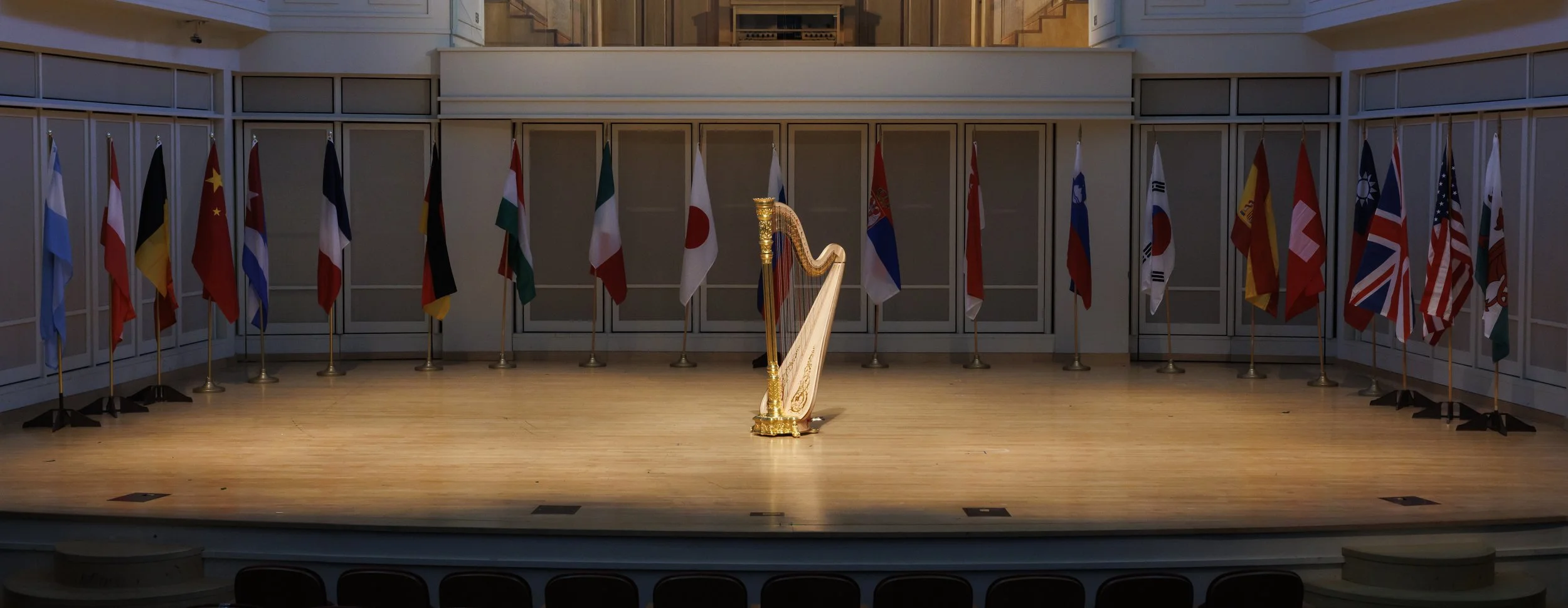
• All stages of the Competition are open to the public and take place on an open stage without a screen.
• Venues are set up consistently for each day of a Stage. This includes identical placement of acoustical curtains as well as placement of reserved seats for jury members.
• Harp movers place the performance harp on stage in a marked and pre-selected position. The placement is the same for all competitors and cannot be changed by the competitor.
• For Stages I, II, and III, audience applause is permitted as competitors enter and leave the stage, and at the completion of their entire performance. There is to be no applause between pieces.
• Competitors draw numbers to determine the order in which they perform. If necessary, minor adjustments may be made to the performance sequence to accommodate each competitor’s desired performance harp. The order of performance is used throughout all stages of the Competition.
• After 10 p.m. Eastern Time on the day of the Opening Ceremony, active competitors may not have any contact with jury members. Questions from an active competitor to the jury must be directed to the Executive Director, who speaks to the jury on the competitor’s behalf.
• Specific time during the Competition will be set aside for the jury to meet with competitors who are no longer active to share performance insights and to answer questions.
• All works must be performed by memory, with the exception of the required 8th USAIHC Ruth Inglefield Composition Contest winning composition in Stage III. There are no numerical score benefits accorded to a competitor who memorizes the new composition.
• For Stages I, II, and III, each competitor may choose the sequence of works to be performed.
• In Stage III, the total of each competitor’s program should not exceed 45 minutes, including breaks between pieces. The Jury President may stop a performance if the competitor’s program exceeds this time limit. One additional minute will be permitted for tuning the harp between pieces.
• If a string breaks during any round of the Competition, the Jury President determines where the competitor should restart the work after string replacement.
• Harps and individual practice room times are provided to all active competitors. Guaranteed practice time is to be consistent for all active competitors. Participants may use their personal instruments at their own liability and cost.
• The results of Stages I, II, and III are posted on a wall near the Competition Office, on the USAIHC website (www.usaihc.org), and on USAIHC social media accounts (@usaihc).
• The announcement of prize winners takes place during the Awards Ceremony immediately following jury deliberations after the Stage IV performances. Results and all prizes are announced publicly from the podium as well as posted on the USAIHC website (www.usaihc.org), and on USAIHC social media accounts (@usaihc) following the Awards Ceremony.
• Applicable deductions shall be withheld from the gross amount of prize payments as required by law. If a deduction or withholding is required, the amount shall be remitted to the appropriate governmental authority within the required time and documentation shall be furnished to the prize winner to support a claim for any entitled tax credit. Import taxes may be applicable for the first prize winner’s receipt of the Lyon & Healy or Salvi harp.
Judging Rules & Procedures
Jury
The jury consists of up to seven internationally recognized harpists, teachers, and musicians. The jury is chaired by a Jury President whose role is to direct the overall conduct and operation of the jury and to assure that the jury adheres to all competition rules and procedures.
• All members of the jury must be present for all stages and deliberations during the Competition.
• Jurors may not vote for a competitor who is currently their student or has been their student at any time during the three years immediately prior to the competition. In the case of masterclasses, jurors must recuse themselves if they believe a student/teacher relationship was established. Jurors must submit a Conflict of Interest Disclosure Form identifying any such relationship prior to the start of Stage I.
• Jury members may not discuss performance or scoring of any active competitor with any other member of the jury.
• Jury members may not discuss performance or scoring of any competitor, whether active or eliminated, with any person outside the jury other than the competitor themselves while the competition is in progress.
• Except for the Jury President in their role on the scoring team, no jurors will be allowed to see the evaluation forms or scoring forms of other jurors.
• Jury deliberations are to be regarded as confidential during and after the competition.
• Jurors may adjust their scores at any time during a given stage. Points may not be changed once the stage’s evaluation scores have been submitted and accepted by the Jury President for tabulation. Jurors are to write a short interpretation of the point score on their evaluation form.
• The jury will award all prizes and there will be no ties.
• The decisions of the jury are final.
Adjudication
Each Stage is to be evaluated independently. Competitor performances are to be judged based on the following guidelines and awarded points in each category up to the specified limit, no more than 55 total points:
• Technique – clarity, finger and pedal facility, tone quality, tuning (15 points)
• Accuracy – note accuracy, rhythmic accuracy, tempi, memorization (15 points)
• Musicianship – artistry, phrasing, dynamics, balance (15 points)
• Performance – style, poise, stage presence (10 points)
After each stage, jurors must submit their completed evaluation forms to the Scoring Team, consisting of a non-harpist member of the USAIHC Board of Directors and the Jury President. The Scoring Team will calculate the average score of each competitor to determine which competitors will advance. Only the members of the Scoring Team are permitted to view the evaluation forms and summary point totals of the jurors.
Scoring System
Competitors have been accepted based on a selection committee review of submitted application materials. The USA International Harp Competition promotes the highest international standards of excellence in solo harp performance and consists of four stages:
• Stages I and II are preliminary stages.
• Stage III is the semi-final prize stage.
• Stage IV (Final Stage) is the medal stage.
In each stage, the jury will award points in each category up to the specified limit, up to 55 total points for each performance. The Average Score for each stage is determined by the sum of points awarded, divided by the number of jury members who voted for that competitor. The Average Score is used to determine rank results in Stage I and II and will be used to calculate weighted scores in Stage III and IV.
• Stage I – A minimum of 20 competitors will advance to Stage II and a maximum of up to 22 may be advanced as determined by the Jury President.
• Stage II – The eight highest scoring competitors will advance to Stage III.
• Stage III – The three highest scoring competitors will advance to Stage IV, and the 4th through 8th prizes will be awarded based on the Stage III Weighted Score.
• The Stage III Weighted Score is comprised of 20% of the Stage I Average Score, plus 30% of the Stage II Average Score, plus 50% of the Stage III Average Score.
• Stage IV – The Stage IV Weighted Score will award the Gold, Silver, and Bronze Medals.
• The Stage IV Weighted Score is comprised of 60% of Stage III Weighted Score plus 40% of Stage IV Average Score.
Special Prizes
• All special single work performance prizes will be awarded by jury ballot.
• The competitor who receives the greatest number of votes wins the prize. If two or more competitors receive the same greatest number of votes, the jury will vote again from among the contenders only.
• If the votes are tied after the second ballot, the Jury President will cast the deciding vote. If the jury president has a student in contention, the jury alternate will cast the deciding vote.
• Any harpist who has had access to the 9th Ruth Inglefield Composition Contest winning composition prior to publication is not eligible to receive the prize for its Best Performance.
